What it means for webshops and marketplaces
The EU has rewritten the rules on product safety. As of 13 December 2024, the General Product Safety Regulation (EU) 2023/988 (better known as GPSR) is fully applicable. It replaces the old General Product Safety Directive (2001/95/EC) and brings product safety into the reality of modern commerce: online sales, marketplaces, cross-border supply chains, and platforms that play more than one role at the same time.
If you sell consumer products in the EU, this applies to you. If you run a webshop, especially a multi-category one, this definitely applies to you.
What is GPSR, in simple terms?
GPSR is the EU’s safety net for all consumer products sold in the EU. It:
- Applies to B2C products (not pure B2B, unless consumers are likely to use them).
- Covers offline and online sales.
- Fills the gaps where no sector-specific legislation exists.
- Complements sector laws (cosmetics, electronics, medical devices, etc.) for risks they don’t cover.
In short: if a product can harm a consumer, GPSR cares.
Scope: one webshop, multiple rulebooks
GPSR applies to:
- Products without specific EU safety legislation
- Products with specific EU legislation, but only for risks not already covered
This matters because many webshops sell across categories. A single store might offer:
- Cosmetics (sector-regulated)
- Electronics (sector-regulated)
- Accessories, home goods, or lifestyle products (often not)
Each category can trigger different obligations, sometimes on the same website.
Online or offline? Doesn’t matter
GPSR does not distinguish between physical shops, webshops, marketplaces, apps, distance sales.
If the product is made available to EU consumers, GPSR is in play.
Who has obligations under GPSR?
GPSR doesn’t just target “manufacturers.” It assigns responsibilities to every economic operator involved in putting a product on the EU market.
These roles include:
- Manufacturers
- Authorised representatives
- Importers
- Distributors
- Providers of online marketplaces
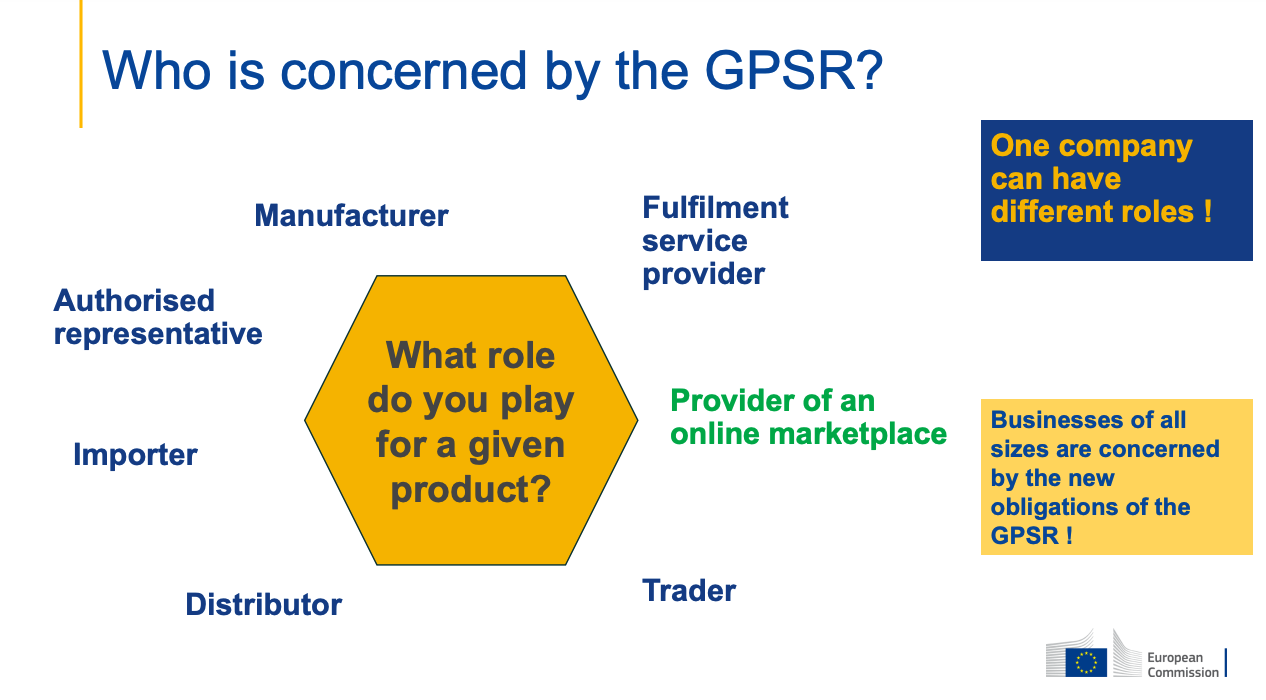
And here’s the key point many businesses miss: roles are not exclusive.
The same company can be:
- A marketplace for some products
- A distributor for others
- A manufacturer for its own private-label goods
When that happens, all relevant obligations apply, at the same time, per product.
Obligations by role (short and sharp)
Manufacturers
Manufacturers must:
- Design products that are safe
- Perform risk assessments and maintain technical documentation
- Provide product identification and traceability
- Include warnings and safety instructions
- Set up complaint handling and keep a complaints register
- Report dangerous products and accidents via the Safety Business Gateway
- Act fast when risks appear
They can appoint an authorised representative, but responsibility doesn’t magically disappear.
Importers
Importers must:
- Verify that products meet general safety requirements
- Refuse unsafe products before placing them on the market
- Display their contact details on the product
- Ensure correct instructions and safety information
- Take responsibility during transport and storage
- Notify authorities and manufacturers if a product is dangerous
Distributors
Distributors must:
- Check that manufacturers and importers did their homework
- Stop unsafe products from being sold
- Inform authorities and other operators if a risk is identified
- Cooperate on corrective actions and recalls
Online marketplaces: the big shift
Under GPSR, webshops and platforms are no longer passive hosts.
If your site allows consumers to conclude distance contracts with traders, you are a provider of an online marketplace under Article 22.
That includes most modern webshops.
Core obligations for online marketplaces
You must:
- Set up two single points of contact
- One for market surveillance authorities
- One for the public
- Register with the Safety Gate portal
- Have internal product safety processes
- Prevent listings from going live unless minimum safety and traceability data is provided
- Perform random safety checks, including against Safety Gate data
- Act quickly on authority orders and third-party notices
- Ensure removed listings do not reappear
- Inform consumers directly in case of recalls
- Cooperate with authorities and economic operators
And yes, this applies even if you didn’t manufacture the product.
Wearing multiple hats? You inherit multiple duties
If your marketplace also:
- Sells its own branded products, you are a manufacturer
- Stocks and ships products, you may be a distributor
- Imports goods from outside the EU, you are an importer
GPSR is explicit about this. The Commission repeats it. Safety Gate confirms it.There is no “but we’re mainly a platform” escape hatch.
What this means for your product pages
At a minimum, every product detail page must show:
Product identification
- Product name/type
- Clear product image
- Any relevant product identifier (SKU, model, batch, etc.)
Manufacturer information
- Name or registered trade name
- Postal address
- Electronic contact details
Responsible person (if manufacturer is outside the EU)
- Name
- Postal address
- Electronic contact details
Safety information
- Warnings
- Instructions
- Any safety notices required for proper use
If this data is missing, the product should not be publishable. That’s compliance by design.
Communication channels: not optional
You must provide:
- A dedicated contact for authorities
Example: compliance_authorities@yourshop.com - A contact point for consumers on product safety issues
Example: compliance_consumers@yourshop.com
These should be easy to find and clearly labelled.
Recalls: what GPSR expects
If a product is recalled, you must:
- Directly contact all affected consumers
- Publish recall information clearly on your site (banner, alert, or notice)
- Share information with authorities and relevant operators
Silence or slow reactions are no longer acceptable.
A smart addition: a Compliance & Safety page
Not mandatory, but strongly recommended. A dedicated page can include:
- Your product safety approach
- Compliance processes
- Contact details for authorities and consumers
- Manufacturer information
- Active and past recalls
It reduces friction, builds trust, and makes audits less painful.
GPSR doesn’t introduce exotic new ideas. It does something more dangerous: it enforces responsibility across modern, messy supply chains.
If you run a webshop or marketplace in the EU, GPSR is not just a legal update. It’s a design, content, and process issue.
Ignore it, and you’ll feel it later, through takedowns, recalls, or uncomfortable conversations with authorities. Handle it properly, and it becomes part of running a serious, credible business in the EU.
